
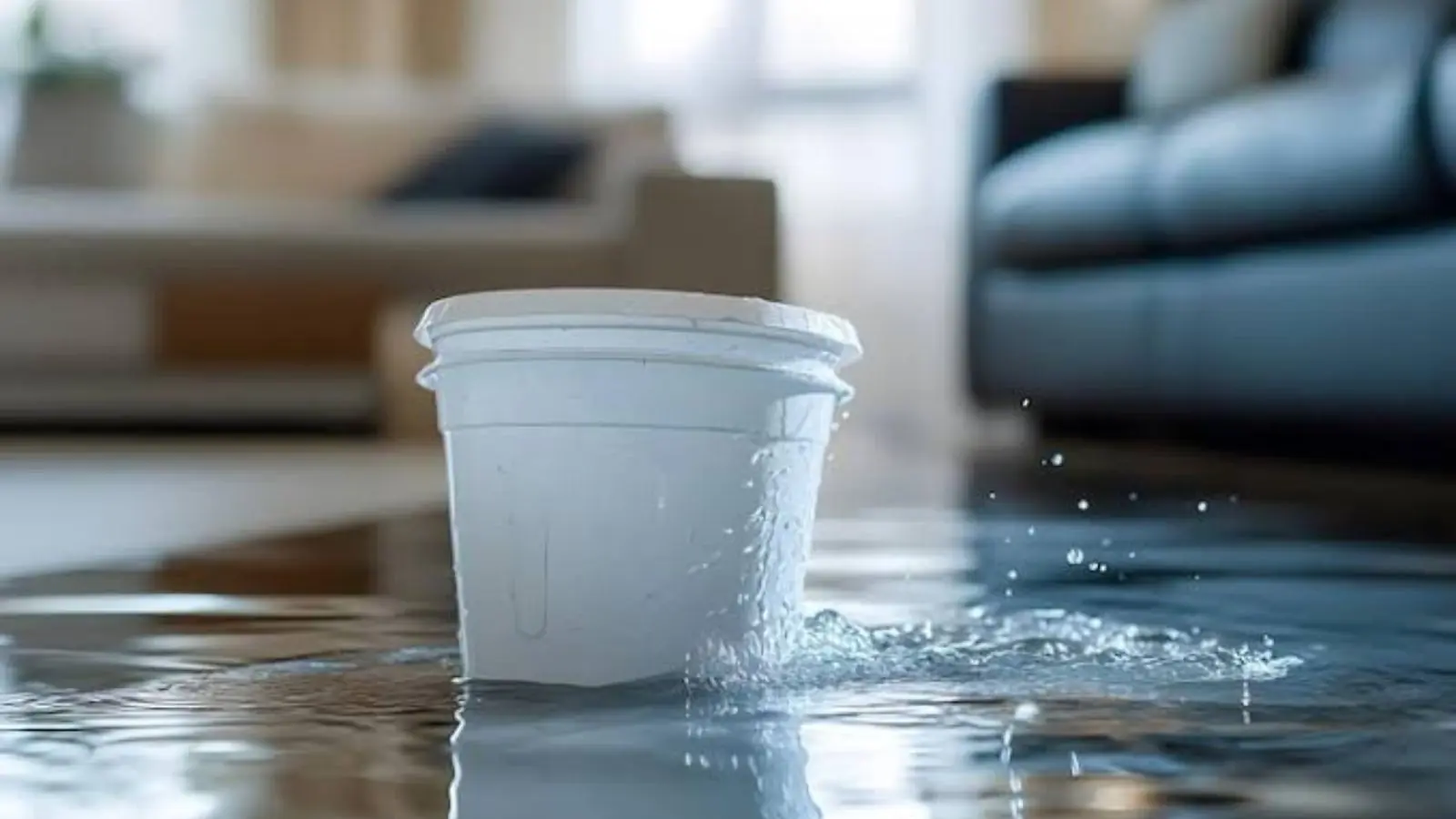
Why a clogged drain line becomes a flood
Your air conditioner pulls moisture out of the air as it cools the house. That water collects in a pan under the coil and runs out through a narrow drain line. When slime, dust or debris plugs that line, the pan fills and spills over the edge.
On a mild day the spill is a trickle. On a 105 degree afternoon, with the system running almost nonstop, the pan can overflow fast enough to soak insulation, a closet floor and the drywall around it before anyone is home to notice.
Where the water ends up
The path depends on where the air handler sits. Many La Quinta homes have it in a hallway closet, a garage corner or an attic, and each location puts different materials in the line of fire.
If the unit is in the attic, the first sign is often a ceiling stain that spreads in a brown halo. If it is in a closet, look at the carpet or flooring along the base. If the line runs inside a wall, the clue is a damp baseboard on the wall beside the closet.
- Water around the base of the air handler or inside the metal drain pan.
- A ceiling stain or sagging drywall under an attic unit.
- Wet carpet or a swollen floor edge in the closet and the hallway outside it.
- A musty odor near the vents that gets stronger when the AC starts.
- An AC that shuts off by itself, which can mean a safety float switch tripped.
What La Quinta homeowners should know about summer AC
Summer afternoons in La Quinta regularly top 100 degrees F, and the valley sits under 4 inches of rain in a normal year. That means your AC works hard for months while the air outside gives it almost nothing to slow it down. A system that runs that long produces a lot of condensate, so a drain line that was marginal in May can fail in July.
Electric service here comes from Southern California Edison or Imperial Irrigation District depending on your address, and your bill shows which. Water near an air handler means wiring and a control board are close by. If you see sparks, smell burning or have a downed line outside, call 911 or your electric utility before you call anyone about the water.
What to do first when you find water at the unit
Switch the thermostat to off so the system stops making more water. If the breaker panel is in a dry spot and you can reach it standing on dry ground, shut off the air handler breaker. Never step into standing water near the unit or touch the wiring.
Next, soak up what you can with towels, lift anything stored in the closet and take photos of the pan, the floor and any stain. A wet vacuum is fine for shallow water on a hard floor, but leave soaked carpet and wall cavities to the crew. If water has reached carpet, insulation or drywall, call (760) 769-1159 and tell us where the unit sits and how long it has been running.
How the water gets removed and the structure gets dried
A crew starts by extracting standing water, then uses moisture meters and a thermal imaging camera to find where it traveled. Closet floors, baseboards and the lower few inches of drywall are the usual targets. Our emergency water removal work runs 24/7 because the water keeps moving until it is pulled out.
Condensate can carry slime and debris from the line, so crews handle it with care rather than treating it as clean rainwater. Wet pad and insulation are normally removed. Air movers and dehumidifiers dry whatever can be saved, and the crew checks readings until the materials return to dry standards.
Table: what is usually done with each wet material
This is the typical sequence for an AC closet loss. Your crew will confirm each call after measuring.
| Wet material | Common outcome | Reason |
|---|---|---|
| Closet carpet and pad | Pad removed, carpet lifted and dried or replaced | Pad holds water against the floor |
| Drywall at the base | Dried if firm, cut out if soft or stained | Gypsum loses strength when saturated |
| Attic or wall insulation | Replaced where soaked | Wet insulation does not dry well in place |
| Baseboard and trim | Often removed and reset or replaced | Wood swells and traps moisture |
| Tile or sealed floor | Extracted and dried, subfloor checked | Water travels under hard surfaces |
Fixing the line and rebuilding what was lost
Drying is only half the job. Have an HVAC technician clear the line, inspect the pan and confirm the float switch works, or the next hot spell will repeat the loss. Neighbors in Coachella and Rancho Mirage deal with the same cycle every summer.
After drying, the damaged drywall, trim, flooring and paint need rebuilding, which is the scope of water damage repair. Ask the City of La Quinta Building Division before any work that alters structure, electrical or plumbing, since permits are generally needed for that kind of repair.
If water is already pooling at your unit, call (760) 769-1159 and we will talk you through the next steps.
Questions we hear from La Quinta homeowners
How do I know the water came from the AC and not a plumbing leak?
Look at the timing and the location. Condensate shows up only while the AC is running, usually near the air handler or its drain path. A plumbing leak keeps going when the AC is off. A plumber or crew can confirm with a moisture meter if the source is unclear.
Can I pour bleach down the drain line?
Ask your HVAC technician what to use on your system, and never mix cleaners. Bleach and ammonia must never be combined, and some products can damage a coil or pan. Clearing the line properly is a technician job.
Why does my AC closet flood in July but not in April?
Summer heat makes the system run far longer each day, so the pan handles more water. A line that was partly clogged in spring can fail once the daily runtime climbs. In La Quinta, that usually means the first triple digit weeks of the season.
Is an AC overflow covered by insurance?
Sudden and accidental water damage is often covered, while gradual leaks and neglect often are not. An overflow that built up over time may be treated differently from a one-time event. Check your policy and ask your insurer, and keep photos and any service records for the unit.
Do I need to shut off the whole house if the AC closet is wet?
Not unless you find a plumbing leak. Turn off the thermostat and the air handler breaker if you can reach it safely, and leave the main water on. If you cannot tell where the water is coming from, shut off the main water valve to be safe.
Water still spreading? The line is open 24/7.
Call (760) 769-1159