
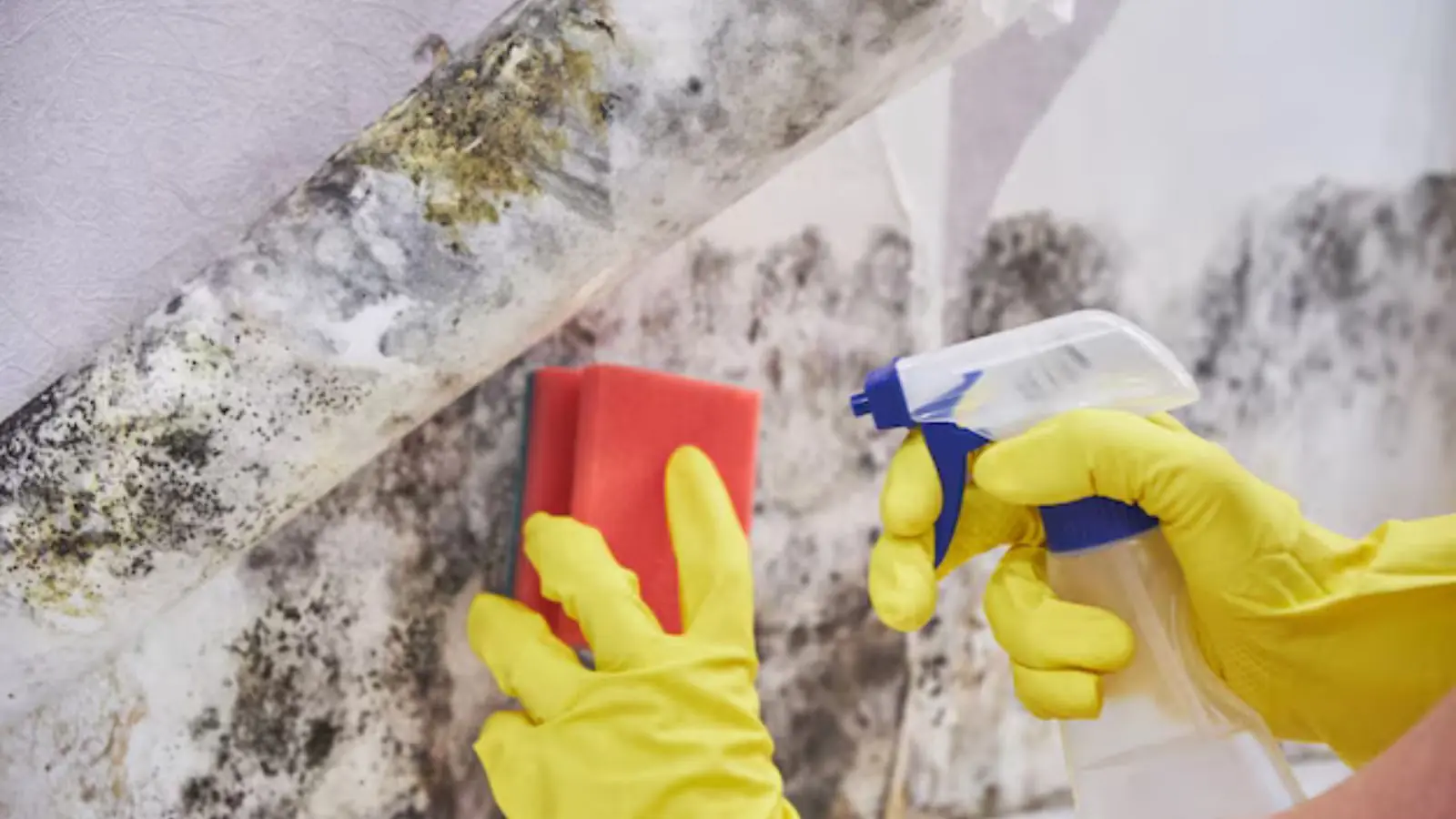
Start with the water, not the stain
Every mold job begins at the same place: where is the water coming from. A roof leak, a sweating AC line, a weeping supply hose and a damp slab edge each need a different fix, and none of them is solved by cleaning the wall.
Find it, stop it, and write down what you found. If you cannot find it and water is still arriving, shut the main water valve and call (760) 769-1159. We are open 24/7 and can check the area with a moisture meter and a thermal imaging camera.
The five steps in order
The process has the same backbone no matter how large the job is. Skipping a step is what turns a one-time cleanup into a repeat visit.
Mold needs moisture, and testing and remediation follow the ANSI/IICRC S520 standard. Questions about health go to a physician, not to a cleaning guide.
- Source: find and fix the leak, condensation or humidity problem.
- Dry: pull out standing water and run air movers and dehumidifiers until readings are normal. This is the work of water mitigation.
- Contain: seal the work area with plastic barriers, and use negative air with HEPA filtration on larger jobs.
- Remove: cut out and bag porous material that cannot be cleaned, and clean hard surfaces.
- Clear: confirm the area is dry and clean, and consider independent testing for bigger jobs.
Small areas versus large areas
Size changes the plan more than anything else. A patch on a tile wall and a stain across a bedroom ceiling look alike in a photo, but they carry very different risks of spreading debris through the house.
Use the table as a starting point. If you are unsure which row you are in, assume the larger one until someone has looked.
| Size of area | Who handles it | What is involved |
|---|---|---|
| Under about 10 square feet, hard surface | Homeowner, once the leak is fixed | Detergent and water, drying, discarding rags, no mixing cleaners |
| Under 10 square feet but on drywall, carpet or ceiling tile | Homeowner or a pro, depending on how deep it goes | Porous material usually gets cut out and bagged |
| 10 to 30 square feet or more than one room | Professional crew | Containment, HEPA vacuums and air scrubbers, controlled removal, mold remediation |
| Hidden in walls, HVAC or after major water loss | Professional crew and independent tester | Wall opened, systems inspected, clearance testing |
What not to do
Do not run a fan on the moldy area and push air across the house. Do not paint over it, because paint does not stop moisture and the stain bleeds through. Do not combine cleaners, and never mix bleach with ammonia.
Do not tear out a large section of drywall without plastic sheeting taped around it. The dust you create gets carried by your AC system into every room. If you must open a wall to look, turn the AC off first, cut a small inspection hole, and photograph what you see before deciding anything else.
What La Quinta homeowners should know
The EPA says drying wet materials within 24 to 48 hours usually prevents growth, and that a homeowner can often clean hard surfaces under about 10 square feet. Past that size, or past that time window, the job calls for professionals. In a desert house with the AC running, a leak can be dry on the surface and wet inside the wall, so measure instead of guessing.
Know your main water shutoff before you need it. The Coachella Valley Water District serves about 1,000 square miles of the valley, but Desert Water Agency, Mission Springs Water District and city utilities cover other addresses, so read your water bill to confirm which utility serves you. Knowing that, and where the valve is, lets you stop a leak in seconds.
When to hand it off
Call a crew when the area is bigger than the table says you can manage, when it keeps returning, or when you cannot find the water. We also take the job when the wet material is behind a wall, because opening it without containment spreads the problem.
Neighbors in Palm Desert and Coachella call with the same questions. Describe what you see, send photos if asked, and a dispatcher will tell you whether it sounds like a crew job. A call costs nothing to make, and the earlier the wet material is found, the less of it has to come out. Call (760) 769-1159 any hour of the day or night, since we are open 24/7 and a leak does not keep office hours.
Questions we hear from La Quinta homeowners
Can I get rid of mold with vinegar or bleach?
The EPA does not recommend routine bleach use, and bleach must never be mixed with ammonia. On hard surfaces, detergent and water plus fast drying is the usual advice for small areas. The cleaner matters less than fixing the moisture.
How do I know if I can handle it myself?
Ask three questions. Is the source fixed and dry. Is the area under about 10 square feet. Is it on a hard surface. If the answer to any is no, call.
Do I need testing to confirm it is gone?
For small jobs, usually not. For larger jobs, independent clearance testing gives you written proof. Ask the tester to be separate from the company doing the work.
How long does it take to dry out after a leak?
It depends on the material and how wet it got. Surface water on tile can dry in a day, while wet drywall and framing need equipment and readings. Pros dry until a meter says the material is back to normal, not until it feels dry.
Where is my water shutoff in a typical La Quinta home?
Many homes have a main valve near the street meter box and another where the line enters the house, often by the water heater or on an exterior wall. Find both now, label them, and confirm your water utility from your bill. If you cannot reach them, tell the dispatcher when you call.
Water still spreading? The line is open 24/7.
Call (760) 769-1159