
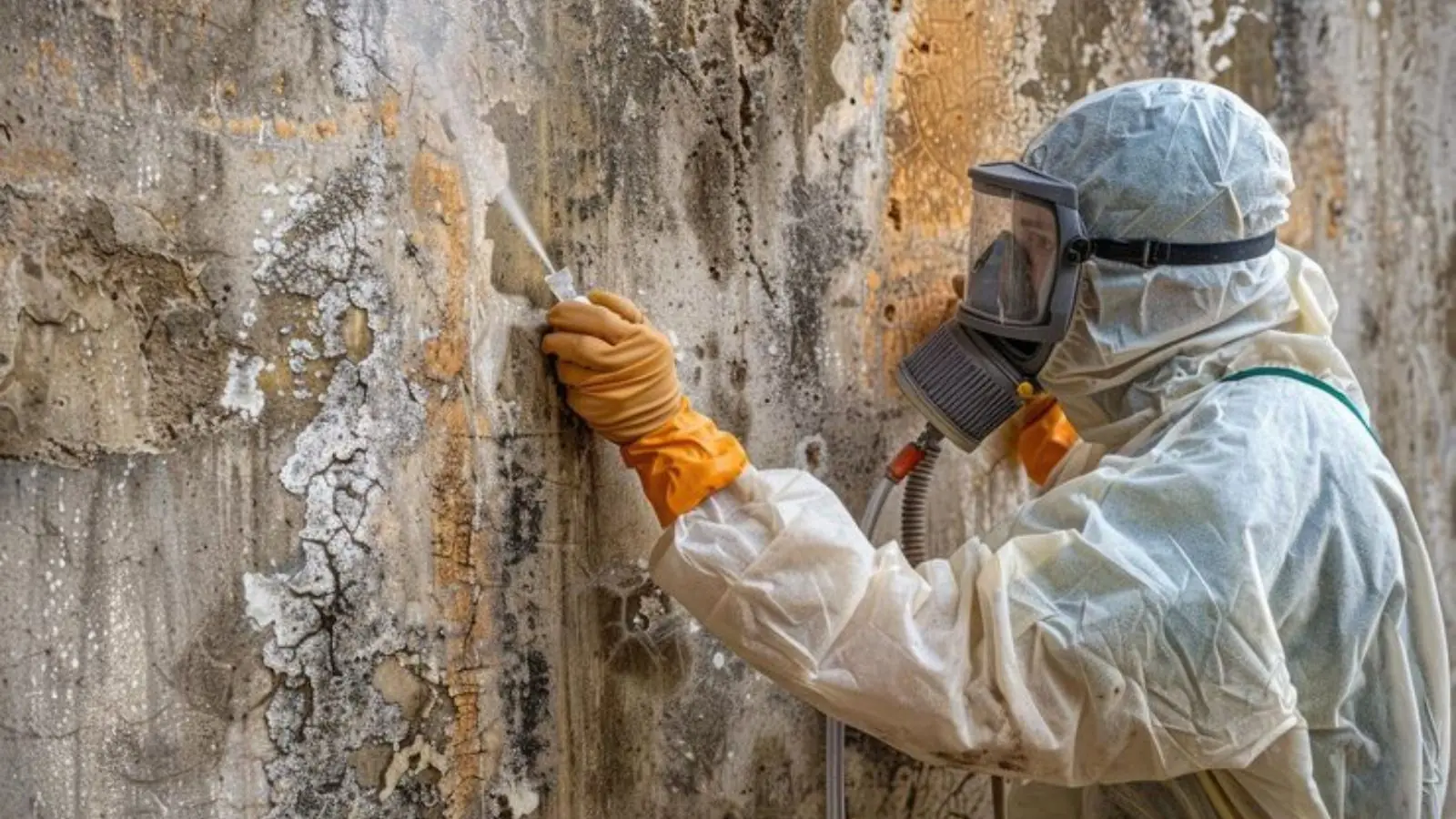
Why wood is harder than tile
Glass and tile have a skin. Wood has millions of tiny channels that pull water in and hold it. Growth that looks like a dark smudge on the top layer may have roots several millimeters down.
That is why advice written for bathroom grout fails on a stud or a dresser. Mold needs moisture, so the first question is never what to spray. It is why the wood got wet and whether it is still damp.
Surface growth versus embedded growth
Surface growth sits on sealed or finished wood and wipes off with a cloth, leaving the grain clear. Embedded growth leaves a stain that does not wipe away, or the wood feels soft, fuzzy, crumbly or lighter than it should. Press a screwdriver tip into the board. If it sinks in more easily than it should, the wood is compromised.
A small, hard, finished surface with light growth is something a homeowner can often handle. Anything porous, soft or larger than about 10 square feet is a different job. Testing and remediation follow the ANSI/IICRC S520 standard, and health questions go to a physician.
Framing, furniture and decks are three different problems
A wall stud, a dining table and a back-patio deck all grow mold for the same reason but call for different decisions. The cards below sort them by what is at stake.
Framing inside a wall
Hidden behind drywall, so the wall has to be opened to see it. Light surface growth on solid framing can often be removed by HEPA vacuuming and sanding under containment. Soft, sagging or split studs get replaced. This is the work covered by mold remediation.
Furniture and cabinets
Solid wood with a good finish can sometimes be cleaned and dried in open air. Veneer, particleboard and upholstered frames soak and swell, so they rarely recover once colonized. Weigh the repair cost against the piece.
Decks, fences and pergolas
Outdoor wood is built to get wet, but when it stays wet from sprinklers or a leaking hose bib, growth settles in. Dark patches on sound boards can be cleaned and dried. Boards that flex, splinter or crumble are replaced.
Why scrubbing is not remediation
Scrubbing moves material around. A brush on a rough board pushes spores into the grain and up into the air, and the room ends up with more airborne debris than it started with. If the wood stays damp afterward, you have cleaned the surface of something that is still being fed.
Remediation is a process, not a motion. It fixes the water source, dries the wood to a measured level, contains the area, removes growth with HEPA vacuums and controlled sanding or cutting, and then checks the result. Skipping the drying and containment steps is where most do-it-yourself jobs go wrong.
What La Quinta homeowners should know
The EPA does not recommend routine use of bleach as a biocide, and it says never to mix bleach with ammonia. Bleach is mostly water and soaks into wood without removing what is growing inside it. Use detergent and water on small hard surfaces, dry them quickly, and call for help on anything bigger.
La Quinta gets under 4 inches of rain in a normal year and sits against the Santa Rosa Mountains, so unprotected outdoor wood usually stays dry. That is exactly why a deck or fence with mold stands out here. It usually means a sprinkler is hitting the boards, a hose bib is leaking or a planter is trapping water, and moving the water fixes the cause.
Sand, seal or replace: how to decide
Sanding makes sense when growth is shallow and the wood is solid underneath. Sealing comes afterward and only on dry, clean wood, since a coating over damp or colonized wood traps the problem. Replacement is the answer when the wood is soft, split or stained all the way through.
Framing often falls under water damage repair once the growth is removed and the structure is rebuilt. Homeowners in Indian Wells and Coachella ask us the same question: can this board stay. Photos and a screwdriver test usually tell us. Describe what you see to dispatch on (760) 769-1159 and we will sort out the next step.
| Wood condition | Typical next step | Notes |
|---|---|---|
| Light growth, finished surface, firm | Clean with detergent and water, dry fully | Small areas only |
| Stain that will not wipe off, wood is firm | Controlled sanding under containment | Then seal after drying |
| Soft, crumbly or split | Replace the board or member | Fix the water source first |
| Hidden inside a wall | Open the wall and assess | Work to S520 |
Questions we hear from La Quinta homeowners
Is there anything that instantly kills mold on wood?
No. Surface growth can be removed, but wood that stays damp lets it return. The only reliable approach is to fix the moisture, dry the wood and remove what cannot be cleaned.
Can I use bleach on wood?
The EPA does not recommend routine bleach use as a biocide, and it never belongs in the same bucket as ammonia. On porous wood it mostly stays at the surface. Use detergent and water on small areas and ask a professional about larger ones.
Does sanding make mold worse?
It can, if it is done in an open room. Sanding throws fine particles into the air, which is why it belongs inside containment with HEPA filtration. Do not sand a large area yourself.
Can I seal over mold on a deck?
No. Sealer over damp or colonized wood traps moisture and hides the problem. Clean, dry and inspect first, and replace boards that are soft.
Why would a wood fence or deck in La Quinta have mold at all?
Because something is keeping it wet. In a climate this dry, look at sprinkler spray patterns, drip lines, a leaking hose bib, and planters or irrigation draining onto the boards. Move the water source and the wood usually dries within days. If boards are soft after drying, they need to be replaced.
Water still spreading? The line is open 24/7.
Call (760) 769-1159